Foundation problems usually start small. A thin crack. A door that sticks. A floor that feels slightly uneven. These early signs matter because your foundation supports every load-bearing part of your home. If you are already seeing these warning signs, the team behind slab foundation repair wichita falls can evaluate your home before movement worsens. When shifting begins, it tends to spread, and the right repair matched early to the right soil condition is what separates a lasting fix from a recurring problem.
Understanding how structural repair, moisture control, and soil conditions work together is essential when evaluating foundation issues.
What Are Foundation Repair Methods and Why Do They Matter?
Foundation repair methods are techniques used to stabilize, lift, reinforce, or seal a foundation that has shifted, settled, cracked, or bowed. They matter because different methods solve fundamentally different structural problems. Some repairs transfer your home’s weight to deeper, more stable soil. Others stop basement walls from bowing inward, lift sunken concrete slabs, or seal cracks to prevent water intrusion. Using the wrong method can leave the real structural issue completely unresolved, even if the surface looks patched.
What Causes Foundation Damage in Homes?
Most foundation damage traces back to soil movement, water pressure, and loss of support beneath the foundation.
Expansive Soil Movement: Soils rich in clay expand when wet and contract when dry. This repeated cycle pushes and pulls on the foundation. Long-term stability often requires soil stabilization to reduce future movement beneath the home.
Hydrostatic Pressure: When soil becomes saturated, water pressure builds against basement or crawl space walls, causing cracking, bowing, and leaks.
Soil Erosion and Voids: Runoff or plumbing leaks can wash soil from under slabs, leaving empty spaces where concrete can sink.
Freeze-Thaw Cycles: In cold climates, freezing soil expands and lifts foundations. Thawing leads to uneven settling.
Plumbing Leaks Under Slabs: Hidden leaks gradually soften soil beneath the home, leading to slow but measurable settlement.
Identifying the root cause is what determines which repair method will actually stop the movement and not just cover it.
Early Warning Signs You Need Structural Foundation Repair
Structural foundation problems often reveal themselves through a predictable set of symptoms. Watch for stair step cracks in brick or block walls, floors that slope or feel uneven underfoot, doors and windows that no longer close properly, bowing or leaning basement walls, gaps between walls and ceilings or floors, and persistent musty odors from basements or crawl spaces. These signs typically point to structural movement rather than normal aging.
Structural vs. Cosmetic Foundation Repairs
Not all foundation repairs are equal in purpose. Structural repairs correct movement and restore load-bearing support, including steel or helical piers, wall anchors, and crawl space support jacks. Cosmetic repairs seal or cover visible damage but do nothing to stop movement. These include crack fillers, surface sealants, and waterproof coatings. Cosmetic repairs can hide cracks, but they will not prevent future shifting if the underlying soil problem is left unaddressed.
Not sure whether your damage is structural or cosmetic? A professional inspection is the fastest way to know for certain. Schedule a free foundation inspection
Foundation Repair Methods Explained
Methods for Settling and Sinking Foundations
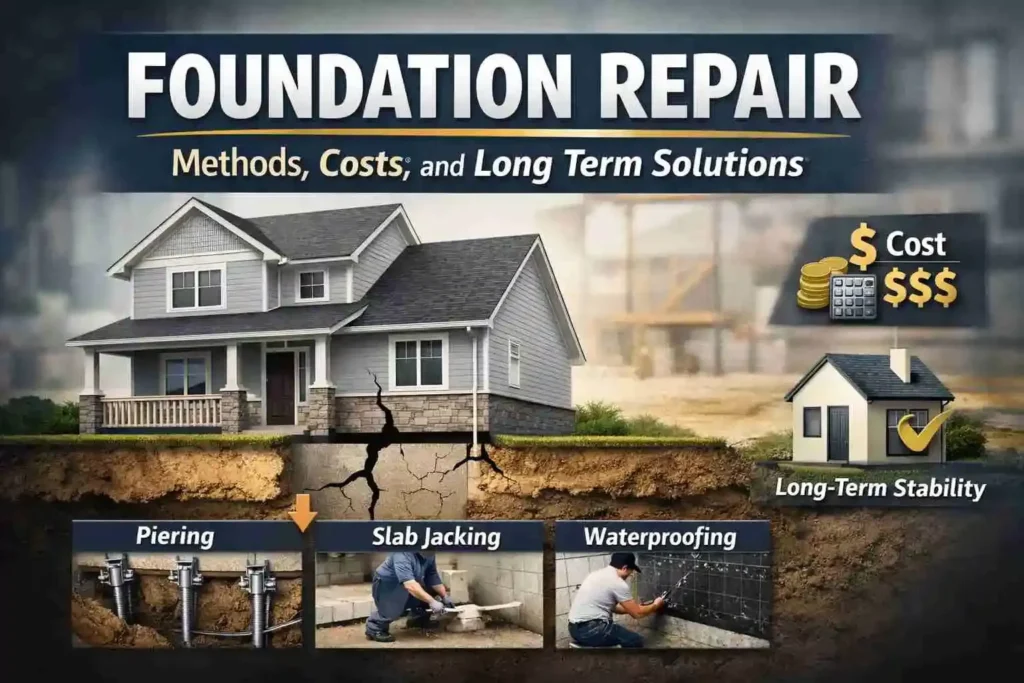
When a foundation sinks due to soil settlement, the goal is to transfer the home’s weight to stable strata. This is typically achieved using steel push piers, helical piers, or poured concrete piers driven deep into the ground. For localized concrete settlement, slab jacking (using polyurethane foam) can lift sunken sections. The exact method chosen depends on the weight of the structure and the depth of the active soil zone. You can learn more about how these stabilization techniques are applied on our foundation leveling page.
Methods for Bowing Walls and Lateral Pressure
Basement walls often bow inward due to hydrostatic pressure from saturated soil. To counteract this, structural methods like wall anchors are installed into the surrounding soil, or carbon fiber straps are bonded directly to the wall to prevent further inward movement. These methods focus on resisting horizontal pressure rather than vertical settlement.
Methods for Cracked and Shifting Slabs
Slab foundations on expansive clay often experience significant stress, leading to cracking. While structural stabilization may be required, non-structural surface cracks are often treated with epoxy or polyurethane crack injection to prevent water entry. For details on how specific cracks are evaluated and sealed, see our foundation crack repair guide.
Methods for Pier and Beam Support
Homes with crawl spaces have a completely different architecture. Repairing them typically involves replacing damaged wooden beams, adjusting shims, or installing crawl space support jacks to correct sagging floors. These techniques are specific to pier and beam foundation repair and do not apply to standard concrete slabs.
Foundation Repair Methods Compared
| Method | Main Problem Solved | Cost Tier | Lifespan | Type |
| Steel piers | Major settlement | High | 50+ years | Structural |
| Helical piers | Moderate settlement | High | 50+ years | Structural |
| Slab jacking | Sunken slabs | Medium | 5 to 15 years | Semi structural |
| Wall anchors | Bowing walls | Medium | Long term | Structural |
| Carbon fiber | Early wall movement | Medium | Long term | Structural restraint |
| Crack injection | Minor cracks | Low | Varies | Cosmetic/sealing |
Which Foundation Repair Method Is Best for Each Foundation Type?
The right method depends heavily on whether the home has a slab, crawl space, or basement foundation.
Slab foundations most often require steel or helical piers for deep settlement, though slab jacking can address smaller sunken areas. For more service details, visit our slab foundation repair page.
Crawl space foundations benefit from support jacks and supplemental piers to stabilize beams and interior supports.
Basement foundations typically call for wall anchors or carbon fiber to address bowing walls, with piers added if the footing itself is settling.
Ready to explore the right repair for your foundation type? Our Wichita Falls specialists assess every foundation individually with no one-size-fits-all diagnosis. View our foundation repair services
Which Methods Are Considered Permanent Foundation Solutions?
Permanent solutions are repairs that transfer structural loads to stable soil layers unlikely to move again. Steel push piers, helical piers, and properly installed wall anchor systems consistently fall into this category. Crack sealing, surface patching, and some slab lifting in active clay soils are not permanent on their own, and their longevity depends entirely on whether movement has stopped.
How Much Do Foundation Repair Methods Cost?
Costs depend on the number of supports needed, soil depth, and access to the foundation. Pier systems are typically priced per pier, with total cost scaling by how many are required. Slab jacking is often priced per square foot. Wall anchors and carbon fiber are usually priced per wall section, and crack injection is priced per crack. Higher costs generally come from deep, unstable soils, limited access, or conflicts with plumbing and utilities. For a full breakdown of what homeowners in the area typically pay per method, see our detailed guide on foundation repair costs in Wichita Falls.
What Is Considered Major Foundation Repair?
Major foundation repair involves structural movement affecting load-bearing elements of the home, including installing multiple piers to lift a settling foundation, stabilizing bowing basement walls with anchors, or addressing widespread settlement causing noticeable floor slope. Minor repairs, by contrast, involve isolated cracks without significant structural shift. If you are facing a major repair, it is worth checking whether your home insurance covers foundation repair in Texas before committing to a budget.
How to Choose the Right House Foundation Fix for Your Situation
Matching the repair method to the severity of movement, soil type, and foundation design is the core of good decision-making here. Four factors matter most: the severity of movement, such as small cosmetic cracks vs. measurable settlement, soil behavior, including expansive clay, erosion, or stable soil, foundation type, covering slab, crawl space, or basement, and desired lifespan, whether short-term patch or long-term structural support. A detailed inspection measuring elevation changes helps pinpoint where structural support is genuinely needed. Because every home and soil condition is different, working with an experienced foundation repair team is the safest path to a long-term solution.
Professional Foundation Repair: What to Anticipate
Most projects follow a clear sequence: inspection and elevation measurements, soil and moisture evaluation, an engineering-based repair plan, installation of piers, anchors, or supports, and final stabilization with site cleanup. Most homeowners can live in their home during foundation repair, though noise and vibration during installation are expected.
Can Foundation Repair Fail? Here Is Why It Happens
Foundation repair can fail when the wrong method is chosen or when soil and drainage issues are never addressed. Common causes include piers not driven to stable depth, ongoing drainage problems that continue saturating soil, slab lifting applied where deep structural support was actually required, and DIY patching that ignores underlying movement. Matching the repair precisely to the soil conditions is what separates lasting results from repeat problems.
How Long Do Different Foundation Repairs Last?
Deep structural supports last the longest. Steel and helical piers are designed for decades of stability. Wall anchors and carbon fiber deliver long-term results when exterior soil pressure is controlled. Slab jacking may need future adjustment in active soils. Crack injection lasts only as long as the underlying movement does not continue.
Preventing Future Foundation Problems After Repair
Controlling water and soil moisture around the foundation is the most effective long-term protection. Improving drainage and grading, extending downspouts away from the foundation, avoiding heavy watering near the slab, and monitoring new cracks early all help preserve the investment made in repair.
When Should You Call a Structural Foundation Repair Specialist?
Call a specialist when cracks grow, floors slope, walls bow, or water enters through foundation cracks. Professional evaluation is especially important when structural movement is visible or appears to be worsening over time.
Seeing any of these warning signs in your home? Do not wait until minor movement becomes a major structural problem. Contact the Wichita Falls foundation experts today.
Frequently Asked Questions About Foundation Repair Methods
Which kind of foundation repair technique is the best?
There is no single best method. The right option depends on soil conditions, foundation type, and severity of movement. Deep pier systems are often used for major settlement, while wall systems address lateral soil pressure.
How can I tell if there is pyrrhotite in my foundation?
Pyrrhotite is a mineral that can exist in some concrete aggregates and cause internal expansion and cracking. Signs may include map style cracking and deteriorating concrete. Confirming pyrrhotite typically requires laboratory testing of concrete samples.
When is the best time of year to fix a foundation?
Foundation repair can be done year-round. Drier seasons may make excavation easier, but structural repairs are not limited to a specific time of year.
Final Thoughts: Choosing a Long-Term Structural Solution for Your Home
Foundation problems rarely resolve on their own. The right repair method depends on soil behavior, foundation design, and how much movement has already occurred.
When the repair matches the structural problem, the result is long-term stability, restored support, and confidence that the home is standing on solid ground.